 Global Fashion Trends
OPI vs Essie: Which Nail Polish Is Worth Your Money?
Introduction: The Drugstore Aisle’s Oldest Rivalry
Walk down any nail polish aisle and two names dominate: OPI and Essie. They’ve been the two best-known names of nail polish for decades — salon staples, celebrity favorites, and the default answer to “what’s a good nail polish?” But they’re not interchangeable, and the right choice depends on your nails, your skill level, and what you actually want from a manicure.
This is a genuine head-to-head comparison: formula, brush, shade range, wear time, price, and all the little differences that matter once you’re painting your nails every week. No brand loyalty, no sponsored slant — just what each one does well, where each falls short, and a clear verdict for every type of polish lover. By the end, you’ll know exactly which bottle deserves your money — and you’ll probably be surprised by how clear the answer is once you see the criteria side by side. If you’re new to doing your own nails, start with our step-by-step guide to painting nails at home — then come back and pick your team.
OPI vs Essie: Quick Comparison Table
| Criteria | OPI | Essie | Winner |
|---|---|---|---|
| Flagship line | Nail Lacquer | Original nail polish | Tie |
| Brush | Wide ProWide brush | Narrower rounded brush | OPI for speed; Essie for precision |
| Shade range | Wide range, bold colors | Wide range, sophisticated palette | Essie (range); OPI (bolds) |
| Typical wear | Several days | Several days | OPI (slight edge) |
| Price per bottle | Mid-range | Slightly lower | Essie |
| Beginner friendliness | Very forgiving | Very forgiving | Tie |
| Long-wear lines | Infinite Shine (3-step) | Gel Couture (2-step) | Essie (simpler system) |
| Limited editions | Frequent, collectible | Frequent, trend-led | Tie |
| Salon presence | Dominant worldwide | Strong, esp. US | OPI |
The short answer: choose OPI if you love bold, saturated color and want the longest wear; choose Essie if you live in neutrals, want the widest shade range, and like paying a little less per bottle. Choose both if — like most polish lovers — you want it all. The detailed breakdown below explains exactly why.
How We Compared Them
We evaluated both brands’ flagship lines (OPI Nail Lacquer and Essie original) plus their long-wear systems (OPI Infinite Shine and Essie Gel Couture) across eight criteria: formula and application, brush design, shade range, wear time, price and value, limited-edition collections, availability, and the intangibles — the stuff you only learn after your twentieth bottle. These are curated recommendations based on each brand’s long-established reputation and aggregated user feedback, not laboratory testing. Where possible we’ve noted where the brands’ own positioning and the FDA’s cosmetics oversight intersect — both are mainstream cosmetics held to the same safety standards.
Head-to-Head Criteria
Formula and application
Both brands nail the fundamentals: smooth, self-leveling formulas that don’t drag or pool. OPI’s Nail Lacquer is slightly thicker and more pigmented — most shades reach full opacity in two coats, and even notoriously tricky brights behave. Essie’s formula is a touch thinner, which makes it slightly more forgiving on the first coat but occasionally needs a third coat on sheers and pastels. In practice, both are among the easiest polishes to apply at home, which is a big reason they’ve stayed on top for decades. Neither is meaningfully “clean” positioned — both are conventional formulas, and both perform like it.
Brush design
This is the most tangible difference between the two. OPI’s ProWide brush is broad and flat — it covers the nail in fewer strokes, which means faster application and fewer chances to mess up. It’s brilliant for medium to large nails and for anyone who wants speed. Essie’s brush is narrower with a rounded tip — more precise around the cuticle, better for small nails, and easier to control for beginners who flood their cuticles. Neither is objectively better; it’s a hand-size and skill question. Try both once and you’ll know your preference immediately.
Shade range
Essie technically wins on numbers (wider range) and on the sophistication of its palette — the brand practically invented the “elegant neutral” category, and its nudes, soft pinks, and muted tones are unmatched. OPI wins on bold, saturated color and iconic shades: Lincoln Park After Dark, Big Apple Red, Cajun Shrimp — colors with actual cultural footprints. OPI also does themed collections better (the brand’s movie and destination collections are events). If your style is classic and understated, Essie’s range will delight you more. If you want color with personality, OPI.
Wear time
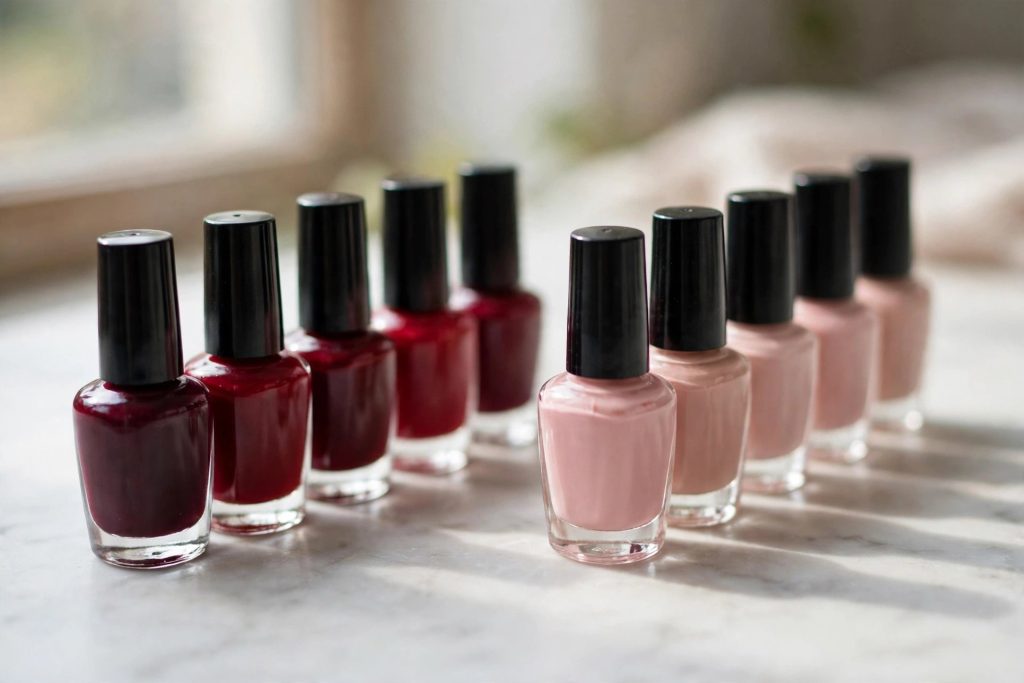
With proper prep (base coat, two color coats, top coat), OPI typically delivers several days of solid wear; Essie lands at several days. The difference is real but small — a day, maybe two — and it shrinks or grows based on your top coat, your nail prep, and how hard you are on your hands. Both brands’ long-wear systems extend this meaningfully: OPI Infinite Shine (primer + color + gloss, no lamp) pushes toward longer wear, while Essie Gel Couture (color + top coat) promises extended wear. Gel Couture’s two-step system is simpler; Infinite Shine’s three-step system is slightly more durable in most users’ experience. For maximum wear from either brand, our guide to salon manicure timing explains why prep matters as much as product.
Price and value
Essie is generally the slightly cheaper bottle — usually a little less at drugstores and on Amazon. Over a year of regular polishing that’s real money, though neither brand is expensive in absolute terms. Value gets more interesting with the long-wear systems: Gel Couture’s two bottles (color + top) cost less to start than Infinite Shine’s three. And both brands’ holiday gift sets periodically offer the best per-bottle prices of the year. Neither brand has a meaningful dupes problem at their price points — they’re the affordable quality tier, not the luxury one.
Limited editions and collections
Both brands release seasonal collections relentlessly, and both do it well. OPI’s collections tend to be bolder and more narrative-driven (Hollywood, Venice, Scotland — each with a story), making them catnip for collectors. Essie’s are more trend-responsive — the brand is quick to bottle whatever’s happening in fashion. Limited editions from either brand can become hard to find, which is fun for collectors and annoying for anyone who falls in love with a discontinued shade. Pro tip: if you love a limited shade, buy a backup. Ask anyone who’s mourned a discontinued Essie.
Availability
You can buy both everywhere — drugstores, beauty retailers, salons, Amazon. OPI has the edge in professional salons globally (it’s the default salon polish in much of the world), while Essie is slightly more dominant in US drugstore aisles. For refills and shade hunting, availability is a non-issue for both. The one caveat: buy from authorized sellers. Counterfeit OPI and Essie are common on marketplace listings, and fakes can contain who-knows-what — stick to reputable retailers.
The Long-Wear Systems: Infinite Shine vs Gel Couture
Both brands offer a “gel-like, no lamp” system, and they’re worth comparing directly since they solve the same problem: longer wear without UV curing.
OPI Infinite Shine is a three-step system: primer base coat, color, and gloss top coat. The primer grips the nail, the color goes on richly, and the gloss cures in natural light to a hard, shiny finish. Real-world wear is typically several days — impressive for a non-lamp system. The downside is the three-bottle commitment and the slightly longer removal (it grips well, which cuts both ways).
Essie Gel Couture is a two-step system: color plus a specially formulated top coat, no base coat needed. It’s simpler and faster, with wear typically lasting several days for most users. The color range is smaller than Infinite Shine’s, but the ease of use is a real advantage — fewer steps means fewer things to get wrong.
Verdict: Gel Couture for simplicity, Infinite Shine for maximum durability. If you want the longest possible wear and don’t mind the extra step, OPI’s system edges it. If you want “almost as good with less fuss,” Essie wins.
Verdict: Which Brand for Which Person?
The beginner: Either one works. Both are forgiving, both have great brushes (pick based on your nail size), and both are affordable enough to experiment with. If forced: Essie, for the slightly lower price while you’re learning.
The bold color lover: OPI. Richer brights, more iconic statement shades, better themed collections. Lincoln Park After Dark alone settles this.
The neutral minimalist: Essie. Nobody does sophisticated nudes and soft tones better. The brand’s entire identity is your aesthetic.
The longevity seeker: OPI, by a small margin — slightly better wear in the flagship lines, and Infinite Shine for the long-wear crown. Though Gel Couture is the easier system, so factor in your patience.
The budget-conscious: Essie. A little less per bottle, and the quality gap is negligible.
The salon-goer: OPI. It’s what your tech probably uses, which means perfect color matching between salon visits and home touch-ups. Our salon cost breakdown can help you decide how much of your routine to bring home.
The collector: Both, honestly — but OPI’s narrative collections are more fun to collect, while Essie’s trend drops are more fun to wear immediately.
The truth most comparisons won’t say: you don’t have to choose. Plenty of polish lovers own both — OPI for brights and statement shades, Essie for neutrals and workweeks. At these prices, the real answer to “OPI vs Essie” is often “yes.” Start with one bottle from each brand in shades you’ll actually wear, and let your nails decide. For keeping those nails healthy enough to show off either brand, our nail strengthening guide is worth a read.
A Brief History of the Rivalry
Understanding where these brands came from explains a lot about what they are today. OPI began in 1981 as a dental supply company — yes, really — before pivoting to acrylic nail products and then lacquer. Its salon-first DNA is why OPI dominates professional settings: the brand was built for nail technicians, with the retail side following later. That heritage shows in the ProWide brush (designed for fast salon application) and the shade naming (witty, place-based, collectible).
Essie took the opposite path. Founded in 1981 by Essie Weingarten in Las Vegas, it started as a consumer brand with a small first range grew through fashion weeks, celebrity manicurists, and an uncanny knack for the perfect neutral. Essie became the brand of the red carpet manicure: the brand’s backstage presence at fashion shows cemented its sophisticated image. Where OPI conquered the salon, Essie conquered the culture.
Today both are owned by beauty giants, which means serious R&D budgets and global distribution. The rivalry persists mostly as a consumer preference thing — professionals tend to stock both. Knowing the history helps set expectations: OPI thinks like a salon brand (performance, speed, bold color), Essie thinks like a fashion brand (trends, elegance, wearability). Neither approach is better; they’re just different philosophies that happen to come in similar bottles.
Iconic Shades, Compared
Every polish lover has opinions about the legendary shades. Here’s how the icons stack up across the categories that matter.
The perfect red
OPI’s Big Apple Red is the archetypal cool red — blue-based, vivid, unmistakable. Essie’s answer is closer to A-List or Really Red, slightly more refined. For pure drama, OPI wins; for a red you can wear to a board meeting, Essie. Both are one-coat wonders in terms of pigment, which is rarer than it sounds in red polish.
The perfect nude
This is Essie’s home turf. Ballet Slippers — the sheer, barely-there pink — is arguably the most famous nude polish ever made, and Essie’s range of skin-flattering neutrals (Mademoiselle, Topless & Barefoot, Sand Tropez) is deeper than OPI’s. OPI’s Samoan Sand and Bubble Bath are excellent, but the brand’s heart clearly isn’t in nudes the way Essie’s is. If you live in neutrals, this category alone justifies an Essie loyalty.
The perfect dark
OPI’s Lincoln Park After Dark — the legendary almost-black purple — against Essie’s Wicked (a deep oxblood red). Both are fall icons; Lincoln Park After Dark has the stronger cult following and slightly better opacity, while Wicked is more wearable day-to-day. Honestly? Own both. They’re different enough to justify it, and our dark romantic nail ideas will give you plenty of ways to wear them.
The perfect glitter
OPI does glitter with more conviction — the brand’s holiday glitters are denser and more dimensional. Essie’s glitters tend to be more refined and less chunky. For New Year’s Eve impact, OPI; for subtle sparkle, Essie. Either way, use a peel-off base or the foil removal method — glitter removal is nobody’s idea of fun.
What Nail Techs Actually Say
We can’t survey every salon, but the professional consensus — echoed across beauty editorial coverage for years — is remarkably consistent on a few points. First: techs reach for OPI when they need guaranteed opacity and speed, especially with dark or bright shades. The formula’s pigment load means fewer coats, which means faster appointments. Second: techs reach for Essie when the client wants elegant, natural-looking nails — the sheers and nudes apply beautifully and look expensive.
Third, and most interesting: most techs don’t have a “better” brand — they have a better brand for the shade. The same technician might grab OPI for a deep burgundy and Essie for a sheer pink in the same appointment. That’s the professional version of our “buy both” verdict, and it’s worth taking seriously: people who paint nails for a living are ruthlessly practical about what works.
The other consistent pro tip: thin coats beat brand choice every time. Two thin coats of either brand will out-wear three thick coats of either brand. Thick polish traps solvents, stays soft underneath, and chips within days. If your manicures never last, the problem is almost certainly application thickness, not whether you bought OPI or Essie. Our at-home painting guide walks through the technique step by step.
The Dupe Question: Are They Worth It at All?
Let’s address the elephant in the aisle: drugstore brands and store brands cost half as much. Are OPI and Essie worth the premium? For most people, yes — but with nuance. The jump from a cheaper to a mid-priced OPI/Essie brings better brushes (the #1 factor in easy application), more consistent formulas batch to batch, and better wear. That’s real value, not marketing.
But the jump from OPI/Essie to luxury polish? That’s mostly branding, packaging, and shade exclusivity. Performance differences at that level are marginal. OPI and Essie sit in the sweet spot: the quality tier where extra money still buys extra performance, before diminishing returns take over. If you’re building a polish collection from scratch, they’re the right place to start — and if you’re deciding between them, this entire guide exists to help you pick your fighter.
One more consideration: cost per manicure. A bottle that yields many manicures costs little per use — compared with salon prices (see our salon pricing breakdown). Whichever brand you choose, at-home polishing with quality lacquer is one of the best beauty bargains there is.
Care and Removal: Making Your Bottles Last
Whichever brand wins your loyalty, a few habits will stretch every bottle further. Storage: keep polish upright in a cool, dark place — heat and sunlight thicken formulas prematurely. Never store bottles on a sunny windowsill, no matter how pretty they look there. If a polish thickens, a few drops of polish thinner (not remover — remover breaks down the formula) will restore it. Application hygiene: wipe the bottle neck clean before closing, and don’t pump the brush — it introduces air bubbles that shorten the polish’s life. Removal: use acetone-free remover for regular polish to be gentler on nails, and give the soaked cotton a full minute on each nail before wiping — impatience causes the rubbing that weakens nails. For the long-wear systems, expect slightly longer soak times; that’s the trade-off for the extra days of wear. Nail health between manicures: give nails a breather day with cuticle oil and no polish now and then, especially if you notice peeling or dryness. Healthy nails hold polish better anyway — our guide to stronger nails covers the full routine. A well-cared-for bottle of OPI or Essie stays perfect to the last drop, which is part of why the price per manicure is so low.
Frequently Asked Questions
Is OPI better quality than Essie?
They’re extremely close in quality — both are professional-grade mainstream brands. OPI has a slight edge in wear time and pigment richness; Essie has a slight edge in price and shade range breadth. The differences are marginal enough that brush preference and favorite shades should decide for you, not “quality.”
Which lasts longer, OPI or Essie?
OPI, by about a day on average — typically several days with proper base and top coat. Their long-wear systems (Infinite Shine vs Gel Couture) both extend wear further. Your prep routine and top coat matter more than the brand difference.
Is OPI worth the extra money over Essie?
The price gap is small — usually a little less per bottle — so “worth it” comes down to whether you prefer OPI’s shades and wide brush. If you do, the premium is negligible. If you prefer Essie’s palette, you’re not sacrificing meaningful quality by spending less.
Can you use OPI and Essie products together?
Yes. Base coats, top coats, and colors are interchangeable between brands — they’re all standard nitrocellulose lacquers. Many people use an OPI base, Essie color, and whatever top coat they like best. The long-wear systems (Infinite Shine, Gel Couture) work best as complete systems, though.
Which brand is better for beginners?
Both are excellent for beginners — forgiving formulas, good brushes, affordable prices. Choose based on brush: OPI’s wide brush for larger nails and speed, Essie’s narrower brush for smaller nails and precision. Either way, start with crème finishes, which are the most forgiving.
Do OPI and Essie test on animals?
Both brands’ parent companies have complex global policies, and animal testing policies can change. If cruelty-free status matters to you, check each brand’s current official policy statement before buying — and note that several indie brands position themselves as cruelty-free alternatives if that’s a priority.
Why is salon OPI more expensive than store OPI?
Salons typically use professional sizes and factor the product into service pricing — you’re paying for the manicure, not just the polish. The formula in the bottle is the same. Buying your salon shade for home touch-ups is one of the smartest polish purchases you can make.
How do I stop my polish chipping so fast?
Cap the free edge (run color and top coat along the nail tip), always use base and top coat, avoid hot water for a few hours after painting, and wear gloves for cleaning. Our favorite beauty publication regularly features nail technicians who all say the same thing: prep matters most for wear time.
Are expensive nail polishes actually better than drugstore ones?
OPI and Essie are the sweet spot — they outperform cheaper polishes noticeably (better brushes, better wear) while costing far less than luxury polishes, where you’re mostly paying for branding. Diminishing returns kick in hard above that.
OPI vs Essie isn’t a rivalry with a winner — it’s a choice between two excellent brands with different personalities. OPI is the bold, salon-dominant icon with the wide brush and the legendary reds. Essie is the sophisticated, slightly cheaper, shade-range champion that owns the neutral game. Buy the one whose shades make you happy, whose brush fits your nails, and whose price feels right — or buy both and stop choosing. The next time you’re standing in the polish aisle feeling torn, remember the cheat sheet: OPI for bold color and salon-grade wear, Essie for elegant neutrals and trend-right shades, and thin coats with good prep no matter which bottle you grab. Decades of manicure lovers can’t be wrong about both of these brands — and now you know exactly which one is yours. Your manicure will look great either way, and that’s the only verdict that really matters. Happy polishing — whichever team you join, your nails are in good hands.